Designing for Trust
The Richmonder | Lead Product Designer
Executive Summary
A new nonprofit newsroom was preparing to launch in a media environment where trust in news organizations had already eroded. Their mission was clear: deliver community-focused, unbiased journalism that prioritized truth over ad revenue, engagement tactics, and sensationalism.
The challenge was ensuring the product experience immediately reinforced the mission. In a landscape dominated by cluttered interfaces, aggressive engagement tactics, and content designed for stickiness, the product needed to communicate something radically different from day one: clarity, credibility, and trust.
I helped translate that mission into product decisions by designing a cleaner, faster, and more trustworthy reading experience that prioritized journalism over platform mechanics.
The result was a successful launch, strong early reception, and a design system that continues to shape the platform today.
The Problem
Most digital news experiences are optimized for business metrics that often come at the expense of trust. Dense layouts, intrusive advertising, endless content stacking, and aggressive attempts to maximize engagement can make readers feel manipulated before they’ve even read a headline.
That model directly conflicted with The Richmonder’s mission.
As a newly launched nonprofit publication, they needed readers to immediately understand that they were fundamentally different from traditional corporate media. They had strong editorial credibility through well-known local journalists, but the product experience needed to reinforce that trust just as quickly.
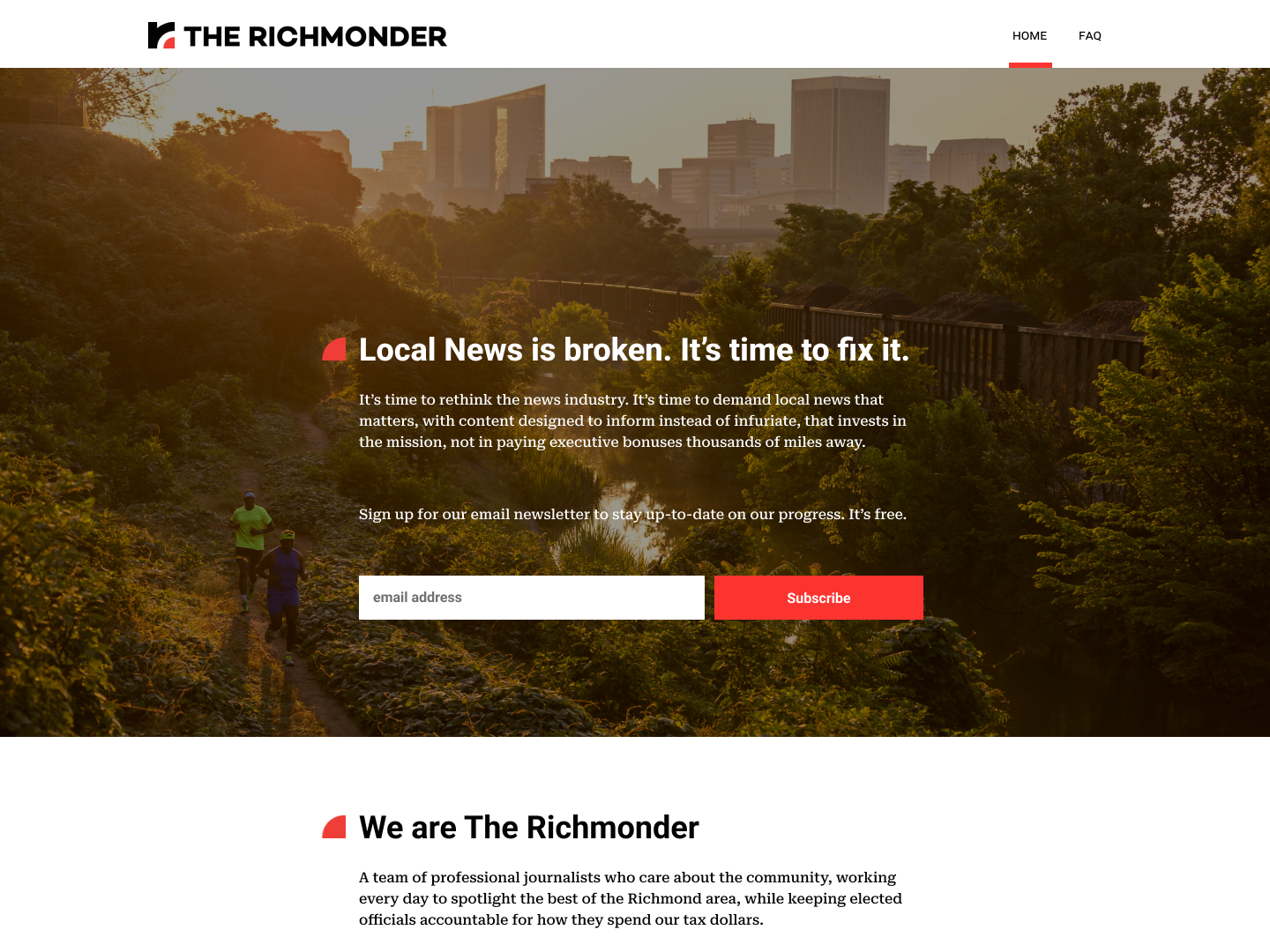
Research with local community members made the problem even clearer. Readers consistently told us they wanted to get directly to the news. They didn’t want visual noise, unnecessary friction, or interfaces that felt like they were competing for attention. They wanted fast access to trustworthy local reporting.
The Process
I helped shape the platform around a simple principle: trustworthy journalism should feel easy to consume.
I studied local nonprofit news organizations across the country and found that many had inherited cluttered design patterns from traditional print media—dense layouts, inconsistent hierarchy, and interfaces that made browsing feel overwhelming.
Rather than replicate those patterns, I intentionally designed for clarity and restraint.
I simplified the visual system to a minimal palette of black, red, and gray so content remained the focal point. I removed unnecessary visual complexity, introduced more whitespace, and created a hierarchy that made articles easy to scan and navigate.
I also designed the reading experience to reduce dead ends. Readers could quickly move between stories through related content surfaced early within articles, while “read next” patterns helped them continue exploring naturally.
Because the platform was launching near local elections, I also expanded the voter guide beyond candidate information by including practical community resources like voter registration and polling location tools.
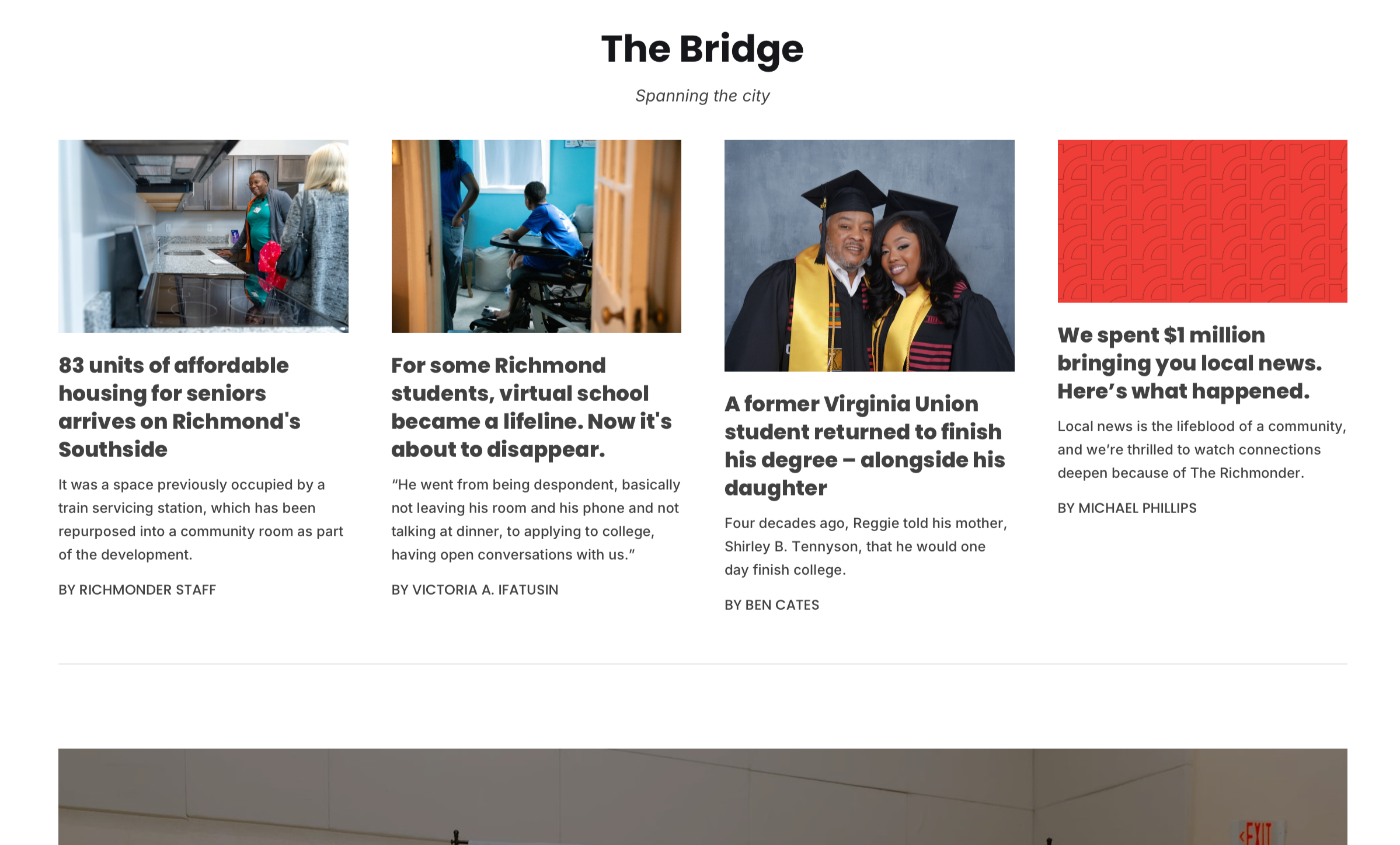
One of my favorite product decisions was creating “The Bridge,” a rotating homepage feature that surfaced major stories from different neighborhoods throughout Richmond. It ensured the platform felt community-centered and reinforced the idea that every part of the city mattered.
Results & Learnings
The platform launched successfully and was met with strong early reception.
Readers frequently praised the site’s clean, modern experience and its contrast with older local news platforms. The publication quickly built momentum as a trusted local news source and has since earned significant recognition, including multiple journalism awards.
The design system created during launch continues to power the platform today.
Sometimes the most important design decision is resisting the patterns that optimize short-term engagement while eroding long-term confidence.
This project strengthened my belief that product design doesn’t just shape usability—it can directly influence whether people trust institutions themselves.